Chromatography columns play a crucial role in laboratory applications. Their design and functionality significantly influence separation efficiency. Choosing the right chromatography column is vital for obtaining accurate results in various experiments.
Each type of chromatography column offers unique advantages and limitations. For instance, some columns excel in separating complex mixtures while others are better for specific compounds. Researchers must understand these differences to make informed choices.
In practice, not all columns perform as expected. Frequent troubleshooting may be necessary. Users often encounter issues like retention time variability or peak broadening. These challenges remind us to continually refine our techniques and selection process.
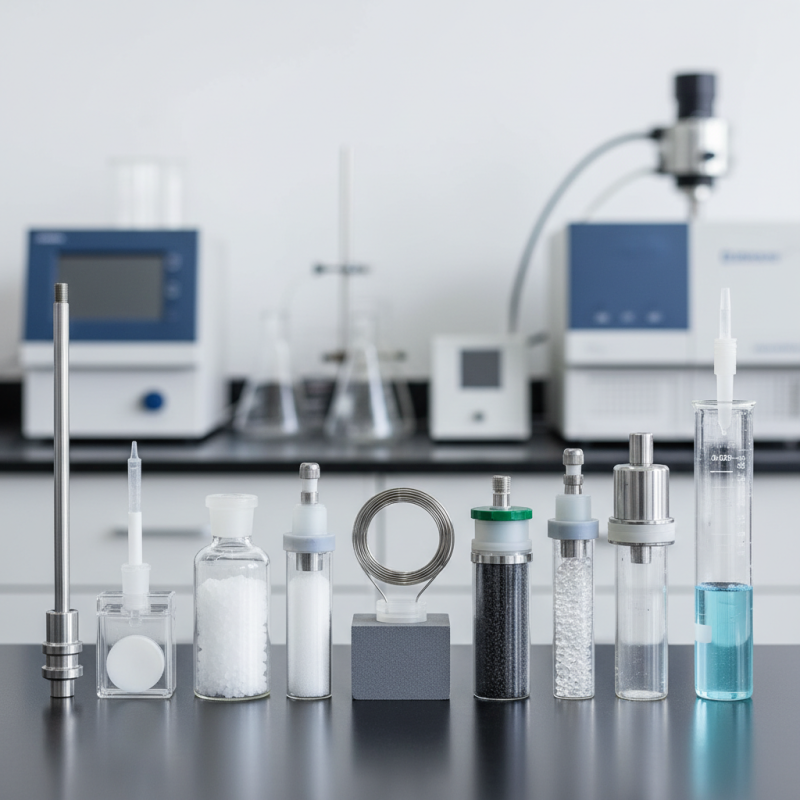
Chromatography columns play an essential role in various laboratory applications. They separate complex mixtures into individual components based on their interactions with stationary and mobile phases. Different types of chromatography columns are tailored for specific applications, making the selection process critical for success.
Popular column types include high-performance liquid chromatography (HPLC) columns, gas chromatography (GC) columns, and flash chromatography columns. HPLC columns are known for their precision in separating compounds in pharmaceuticals. GC columns excel in analyzing volatile substances, while flash chromatography columns offer fast separation for preparative purposes. Choosing the right column can significantly impact results.
Tips: Always evaluate the sample type before selecting a column. Consider factors like particle size and pore diameter for optimal separation results. Each column has limitations, which may lead to subpar results if ignored. Experimentation with different columns is encouraged, as it can reveal unexpected insights.
The choice of stationary phase is also crucial. Different phases interact variably with target compounds. Assessing compatibility can save time and resources. Some columns help isolate specific compounds, but they may not perform well with others. Real-world applications will often reveal these nuances, highlighting the need for careful planning.

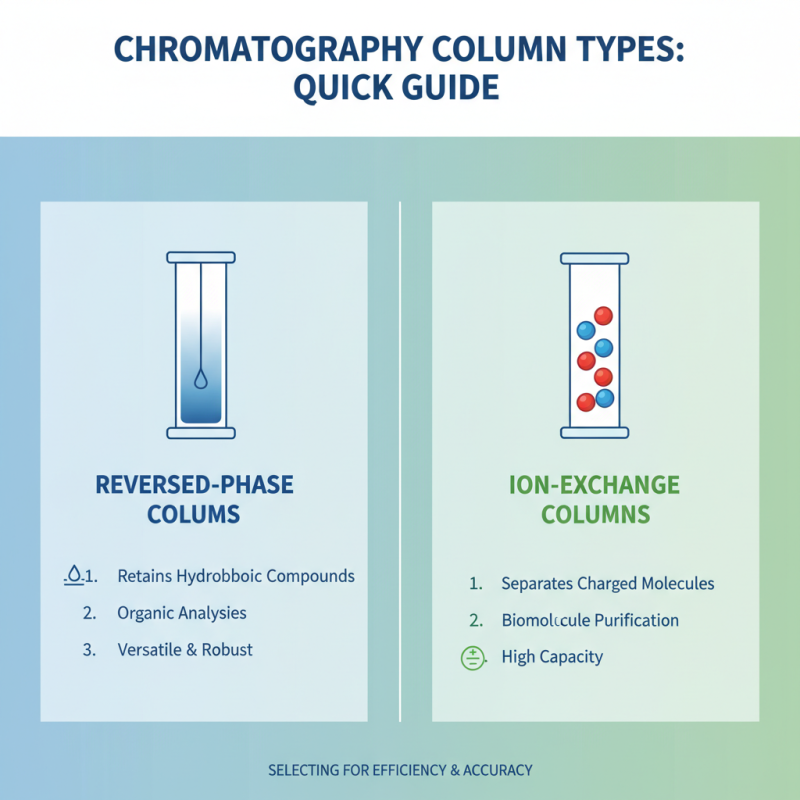
When selecting chromatography columns for laboratory applications, it's essential to understand their unique characteristics and advantages. Each type serves a specific purpose, impacting separation efficiency and analysis accuracy. For example, reversed-phase columns offer excellent retention of hydrophobic compounds. They are a go-to choice for many organic analyses. Their versatility and robustness make them highly sought after in various labs.
Another significant type is the normal-phase column, which excels in separating polar compounds. These columns utilize a silica gel stationary phase and a nonpolar mobile phase. Users appreciate their ability to handle a range of sample types. However, they may require careful control of solvent conditions for optimal performance.
Ion-exchange columns stand out in biochemistry applications. They separate ionic species based on charge. This specificity can be incredibly valuable. Yet, their performance hinges on buffer conditions. Users must be vigilant with pH and ionic strength to achieve reliable results. While these columns provide excellent resolution, they can be tricky to optimize. Each chromatography column type has its strengths and challenges. Understanding these nuances is crucial for effective lab applications.
Partition chromatography columns are essential tools in laboratory applications. They separate compounds based on their distribution between two phases. This technique is widely used in biochemistry and analytical chemistry due to its effectiveness. Understanding the nuances of partition chromatography is crucial for optimal results.
Choosing the right packing material influences separation efficiency. These materials can vary significantly in their affinity for different compounds. Aim to select a material that complements the specific types of samples you analyze. Experimenting with various materials can lead to enhanced resolution and peak shape. Each sample's unique composition may interact differently with your chosen phase.
Keep in mind that temperature and mobile phase composition can alter outcomes. Small adjustments could lead to varying retention times in your samples. Precise control over these factors is key. Regularly reviewing your methodology fosters better understanding and improves results. Documenting these reflections is part of maintaining a reliable process.
Tips: Always validate your method with known standards. Regular maintenance of columns ensures longevity and consistency. Engage in continuous learning, as chromatography techniques evolve rapidly.
Affinity chromatography is a powerful technique used in various laboratory applications. It relies on specific interactions between molecules, such as antibodies binding to antigens. This method is particularly valuable in biochemistry and molecular biology for purifying proteins, enzymes, and nucleic acids.
One advantage of affinity chromatography is its high specificity. Researchers can target desired biomolecules while minimizing impurities. However, this precision comes with challenges. Sometimes, the binding affinities aren’t as strong as expected. This can lead to suboptimal yields. All researchers must monitor purification closely and adjust conditions as needed.
The columns used in affinity chromatography can vary widely in design. Some are packed with beads coated in ligands, while others utilize different materials. The choice of column impacts the effectiveness of the separation. Testing different types is essential for optimizing results. It is a continuous learning process. Factors like flow rate and buffer composition also play significant roles. Understanding these variables aids in achieving better outcomes.
Size-exclusion chromatography (SEC) is a valuable technique in analytical chemistry. It allows researchers to separate molecules based on their size without altering their structure. This method is notable for its gentle separation process, making it suitable for sensitive samples such as proteins or polymers.
When comparing SEC columns, several factors come into play. These include pore size, column length, and the material of the stationary phase. Pore size determines the range of molecules that can be effectively separated. Larger pores accommodate big molecules, while smaller pores are better for tiny compounds. However, choosing the right pore size isn’t always straightforward. It requires careful consideration of the sample characteristics.
Column length plays a crucial role in resolving power. Longer columns generally provide better separation but at the cost of longer analysis times. The material used for the stationary phase also influences the interaction with the sample. Different materials offer various affinities, which may lead to either reliable results or unexpected complications. Careful selection based on the specific application is essential for optimal results.
| Column Type | Particle Size (µm) | Pore Size (Å) | Typical Applications | Operating Pressure (bar) |
|---|---|---|---|---|
| Size-Exclusion Column | 5 | 500 | Protein purification | 30 |
| Affinity Column | 4 | 200 | Antibody purification | 50 |
| Ion-Exchange Column | 5 | 100 | DNA separation | 40 |
| Reverse Phase Column | 3 | 300 | Small molecule analysis | 60 |
| Normal Phase Column | 3 | 100 | Polar compound separation | 50 |
| Hydrophobic Interaction Column | 4 | 300 | Protein recovery | 30 |
| Cation-Exchange Column | 5 | 150 | Metal ion analysis | 45 |
| Anion-Exchange Column | 5 | 150 | Environmental samples | 45 |
| Gel Filtration Column | 4 | 200 | Viral particle analysis | 35 |
| Capillary Column | 1.5 | 50 | Micro-sample analysis | 70 |